

The Concept2 ergometers are unique to the other exercise equipment found in gyms because they accurately measure “the work” that goes into your workout. The Erg’s performance monitor (PM) provides feedback on your pace, cadence, calories and heart rate but the most direct and practical measure of your effort when you are rowing or cycling for example, is your watt output. Watts is a measure of power or how much “work” is done in a given amount of time.
For example, during a 10 minute interval the PM will display your average watts and when you are finished your average watts will determine the distance you have covered for the 10 minutes. If you were to increase your average watts on the next 10 minute interval you will cover more distance. A higher average watts for the same time interval will always result in more distance because you have done more work in the same amount of time. Similarly a higher average watts will give you a faster finishing time for a distance interval.
While exercising the second line on the performance monitor displays your watts per stroke and the third line shows your average watts at any given point in an interval. And a higher watt output will always result in a higher heart rate.
The objective of most cardio (aerobic) exercise is not to maximize your watt output or heart rate but to work at a level of effort that you can maintain. For instance, you might have a target wattage or heart rate zone. Your ability to maintain a higher watt output and heart rate is limited primarily by your aerobic capacity. For this reason you should think of your average watts as indicative of your fitness, not strength, and your heart rate is a response to your watt output.
Surprisingly some erg-based fitness programmes focus more on heart rate than watts. The difference is that watts is a direct and immediate measure of your effort that is accurately displayed on the PM whereas heart rate is a response to your effort and one that is highly influenced by many factors, like heat, caffeine, certain medications and unreliable heart rate monitors that lag behind your effort. Fitness is measured by what you can do, not your heart rate.
Because watts increase in a consistent, linear fashion – tracking your average watts is one of the best ways to monitor your effort and progress, maintain a target workload and to train smarter. Training with watts makes it easier to compare workouts over time, track your fitness and to see if you are improving.
Key Benefits To Training with Watts
- Watts are the most direct measure of how hard you are working. They give a simpler picture of effort and output than your pace (split) or heart rate.
- Watt output is more consistent than heart rate and pace. A 10-watt gain is always a 10-watt gain no matter your fitness level. Whereas gains in pace/split require more effort as you get faster. For example, improving your pace from a 2:30 split to 2:00 requires an increase of approx. 100 watts (from 104W to 203W). However to improve your pace by just half that time from a 2:00 split to 1:45 requires a nearly identical 100-watt increase (from 203W to 302W). See power/pace chart below.
- Your watt output can give you real-time technique feedback. Small improvements or slips in your form will be reflected in your watt output.
- It’s one thing having a target stroke rate or rpm to maintain but holding a steady watt target while rowing or cycling requires a whole other level of concentration and mental focus.
- Whether it is a row for time or distance tracking your average watts is a great motivator and benchmark for measuring improvements over time across a variety of durations.
So if you are a rower, cyclist or Hyroxer chasing a personal best on the erg or you are simply trying to get fitter, watts let you train with purpose and precision and gives you clearer insight into your effort and progress. So don’t just train with weights, train with watts!
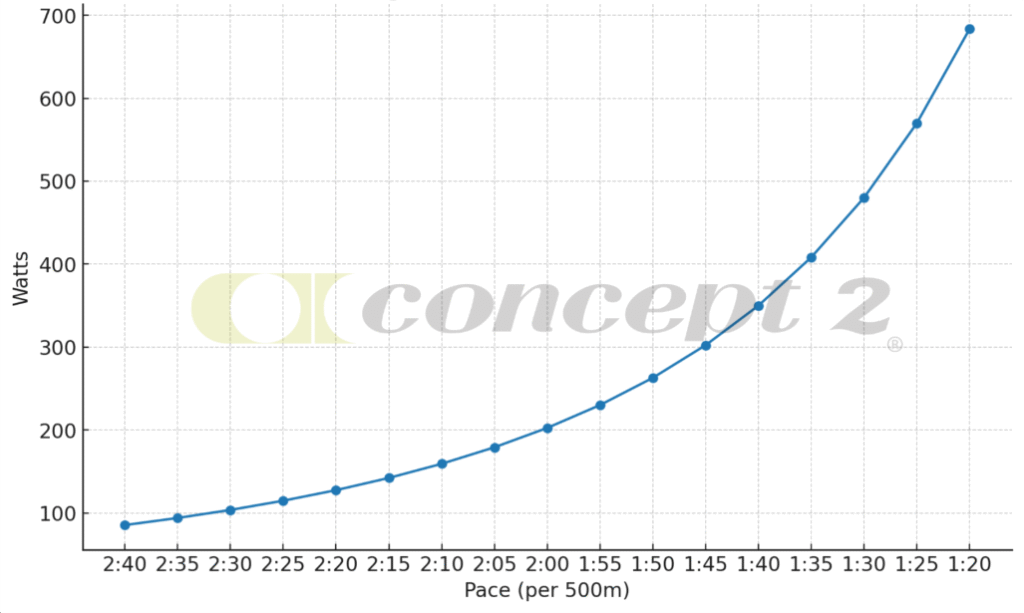 The above shows that the relationship between power (watts) and the effort it takes to improve your pace (split). It is not linear; each second gain at a faster pace demands a larger increase in power.
The Watt Calculator: Check out this handy calculator tool on the Concept2 website to help you determine your watt-based efforts or to convert your pace-to-watts and vice versa.
