Does your workout challenge you? Does it deliver the results you want? How do YOU measure progress? Do you exercise to improve your physical and mental health or do you train to get fitter or stronger? Do you look forward to your workouts or not?
How you answer these questions will likely determine the kind of exercise you do. Whether you like to get your heart racing with cardiovascular exercise, the challenge of lifting heavier weights or whether you prefer more moderate exercise activities like swimming, yoga or golf.
You may prioritize the health and enjoyment aspects of exercise over achieving results and it is important to find an activity that you enjoy and can sustain. But if your goal is to improve your fitness or to get stronger (both of which contribute greatly to better health) exercise intensity is a key factor to your progress. It’s not supposed to be easy!
With a busy work schedule, family responsibilities and life’s stresses it can be easy to take the comfortable option rather than the challenging one. Going easy when the workout gets tough or skipping the workout completely is the most appealing choice. But you need to commit to yourself and challenge your body (and your brain) in order for them to grow. Embracing challenges not only sharpens mental abilities but also increases resiliency and the ability to adapt in all aspects of life.
A recent study from Harvard University found that doing new and challenging things such as exercise or learning a new skill not only promotes brain growth but also improves memory and problem-solving cognitive functions. There is also evidence that when you do something you do not want to do, it triggers parts of the brain that make it grow in size, as well as gives you the tenacity to carry out goals and slow the effects of aging mentally. This helps you tackle not just fitness goals but also gives you the ability to take a handle other life stresses with more resiliency. Embracing a new activity that requires you to think and learn and requires ongoing practice is one of the best ways to keep the brain healthy. Take rowing for example.
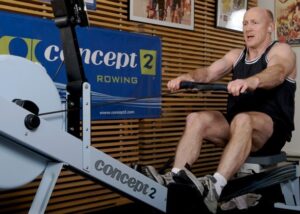
Rowing is a complex, compound whole body exercise that involves most of the major joints and muscle groups of the body, in a coordinated and sustained push and pull movement. Using a rowing machine properly requires you to focus and concentrate much more than exercising on say a stationary bike, treadmill or elliptical machine. The RowErg is entirely user-controlled and unlike the aforementioned, it does not allow you to build up momentum as YOU have to change direction on every stroke you take, all the while managing your timing and effort which is displayed on your performance monitor. The benefits of rowing are as much mental as physical. If it was easy everyone would be doing it!
Here are some ways to help keep yourself accountable or to have others hold you accountable especially when you don’t feel like working out.
1. Schedule your workouts by booking some PT sessions or group exercise classes.
Going it alone, especially when rowing, can be tough, but when you know others are expecting you to show up, it makes it that much easier to follow through. For instance at Community Rowing we emphasize teamwork and if you don’t show up you are letting your teammates down.
2. Stronger Together. There’s power in numbers.
Doing hard things, like interval training, is easier when it is done with a group of other people. Part of the challenge of working out is the struggle to overcome that voice in your head that is telling you to stop. When the going gets tough you are less likely to quit when you know that other people are depending on you.
3. Have a goal.
Training for a specific goal will make your workouts more meaningful and you will be less likely to skip them. It could be your first half-marathon run or Hyrox competition or a weight loss goal. At Community Rowing we recently trained for a team relay half-marathon row and each team member completed a 5K row. Many members got a personal best time and told me about the sense of accomplishment they felt after completing their 5K row.
4. Track Your Progress
It’s said that if you cannot measure it you can’t improve it. If you (or your trainer/coach) do not keep track of your workouts then you won’t know whether you are improving or not. At Community Rowing we use the free Concept2 ErgData app to log our workouts and track progress. ErgData measures and records the work that goes into your workouts with pace, power in watts and heart rate data.
5. Friendly Competition
You don’t have to be the “competitive type” to enjoy a little friendly competition. At Community Rowing we use a variety of race formats to add fun and to spice up our workouts, from team relays to mixed x2 and x4 crews and the new Concept2 Chase and Elimination races.
